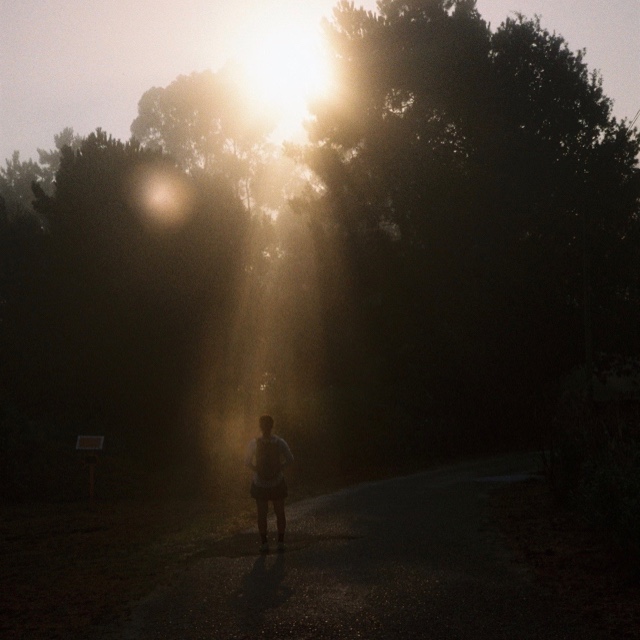

I sat across from her, feeling the pressure build behind my eyes. I leaned on the counter, elbows down with forearms crushed against my chest. The decorative orb meant to light the room hung above me projecting a soft light that was the perfect temperature for highlighting my stiff, frozen glare and darkening my under-eyes.
I was functionally frozen in the midst of a tense discussion — trapped and triggered into using my long-suffering conflict strategy that I developed when I was small.
Freeze. Forget. Dissociate. Defend.
And the defend was new.
Even with the addition, it was an outdated and juvenile strategy, but my body wasn’t ready to forget, and if it didn’t forget, the strategy would never mature. Inevitably, neither would my ability to navigate a conflict.
Recently, I had sunken deeper into this juvenile strategy because for the first time in my life I’m committed to engaging in conflict in the name of deepening relationships, instead of running and keeping a polite distance.
Conflict, as it turns out comes up often, especially when you spend most of your time in close contact with someone, like a roommate, family, significant other, or anyone who isn’t you. For me, with little experience, my nervous system seems fragile, but I know it has just endured a lot.
I was born C-section, so my nervous system was underdeveloped and less capable from the start, and a lot less resilient in the face of adversity of certain kinds.
I grew up in a household that functioned half-conflict avoidant, half-conflict-at-you. Italians usually have no trouble blasting their emotions at each other and resolving them quickly, but as I’ve always said, my family isn’t a culturally-traditional Italian family. We do things our own way (unfortunately. The Italian way looks way more fun).
For a long time, I felt intense fear when conflict would come up. I would sweat as my muscles pressed into my bones, folding me in on myself and making me smaller. An unbearable twisting effect — I did whatever I had to do to make it go away. A wand and a spell book would have been preferable to the techniques I used — mostly fawning, abandoning my own opinion quickly, taking blame just to make the discomfort stop, and mentally transforming any situation into one that shifted blame away from me ASAP. The sooner I believed that I did nothing wrong, the better, and the sooner I was free.
As I stood across from my sparring partner, I fought the freeze. She had just told me her feelings and all I had was an empty head. Come on, say something. But nothing came except a stupid defense that was out of context.
I felt the space between us widening and the pressure in my eyes grew. My stare was becoming angry.
I was angry with myself, but then I caught something else. It was familiar, but a distant feeling.
I stood there and continued cycling through patched-together sentences and rehearsed what I wanted her to know in my head, pleading with myself to just say it. The anger grew.
As I said, the body doesn’t forget the strategies you learn to ‘survive’ and this freeze dance one was no exception.
I flashed back to a time I sat across from my father while he tried to get me to talk to him about something behavioral (I froze a lot as a kid so I often didn’t remember requests like turning off lights, collecting garbage or closing the cabinets).
The more he pushed me to talk, the deeper I became embedded in the ice. I could feel his patience waning. How long had it been? It felt like hours.
I sat, with pressure building behind my eyes, rehearsing an answer to his question, but unable to coax myself to say it. And there it was: I couldn’t do what was being asked of me, so I slipped off away from the conversation to a secluded place in my mind. I was trapped until he gave up. Eventually he would give up, and I was free.
I returned to leaning on the counter looking at her as she waited minutes for just a word from me. The anger began to blaze within me. I am trapped.
I was trapped by myself. I wanted to negotiate conflicts with people close to me. I was tired of the fear of abandonment if I didn’t just agree with others, but I was even more tired of feeling disconnected to people. So, I remained stuck in my freeze, trying to slip away, but tethering myself to the present moment and the strand of connection with the person in front of me. I was so angry that I was making myself stay, and then I transferred the blame and I became angry at her.
She told me that conflict helped build connection. I wanted to believe it, but so far, I only felt more self-protective each time something was resolved. I hated that I did that. I wanted to have close connections just like everyone else. I wanted to be open.
I’ve seen a lot of friendships end over fights. But I guess I’ve seen a lot of friendships continue after fights too. I never understood how people did that. It took a long time to realize that the reason you even fight in the first place is to try to stay in contact and in connection with your friend — to find a way to hear each other and work something out so you can remain close.
Maybe it isn’t that great of an epiphany for anyone else, but I’ve seen plenty of people who fight to win or defend instead of to create closeness, so I can’t be the only one. I guess I developed the sparring perspective from seeing what others did and feeling innately unsafe or unable to stand solid in the face of conflict. Maybe it’s a step up from avoiding engaging at all, but it isn’t any less stressful.
The anger faded off as I became aware of creating my own sensation of being trapped from an old experience. She was in a way trying to bond with me, and I could see it just slightly now.

 Breadcrumbs.